The Science of Deep Work: Balancing a Demanding Master’s Program with Life, Internships, and Wellbeing

Time management is hardly a new challenge for postgraduate students. Most Master’s candidates arrive at business school already skilled at juggling deadlines, projects, and professional commitments. Yet even experienced students often encounter a persistent problem: they feel busy all the time, but not always productive. The concept of “deep work” offers a scientific lens through which to rethink this dilemma and address some common time-management blind spots.

The Origins of “Deep Work”
The term deep work was popularized by computer scientist and author Cal Newport in his book Deep Work: Rules for Focused Success in a Distracted World (2016). Newport defines deep work as “professional activities performed in a state of distraction-free concentration that push cognitive capabilities to their limit” (see a summary here). Such work produces high-value output – whether analytical thinking, strategic decision-making, or complex problem solving.
By contrast, Newport describes “shallow work” as logistical tasks – emails, routine administrative tasks, or fragmented communication – that are cognitively undemanding but consume large amounts of time. In modern knowledge environments, shallow work increasingly dominates the day, fragmenting attention and reducing the capacity for sustained intellectual effort.
The idea resonates strongly in academia and professional education. Research on productivity in universities highlights a “productivity paradox” in which academics and students feel constantly overwhelmed yet struggle to devote uninterrupted time to cognitively demanding tasks.
The Cognitive Science Behind Focus
The science supporting deep work draws on cognitive psychology and attention research. A key concept is “attention residue”. When individuals switch tasks – such as moving from coursework to emails or messaging – part of their attention remains focused on the previous task. This residue reduces cognitive performance on the new task.
What many people casually describe as multitasking is actually rapid task-switching, which carries measurable cognitive costs. Studies show that such switching reduces efficiency, increases errors, and lengthens completion times. Even brief digital interruptions – notifications, messaging apps, or social media – can break the mental momentum necessary for deep concentration.
For postgraduate students engaged in analytical coursework, financial modelling, strategy cases, or thesis research, this fragmentation can be particularly damaging. Complex intellectual tasks require extended periods of sustained attention to allow ideas to develop and insights to emerge.
The Time-Management Blind Spots
Business school students are rarely poor planners, yet several systemic blind spots tend to undermine productivity.
- Mistaking busyness for productivity
Students often measure productivity by hours worked rather than the depth of focus achieved. A day filled with meetings, networking events, and administrative tasks may feel productive while producing little meaningful progress. - Overestimating multitasking ability
Despite strong evidence to the contrary, many individuals believe they can effectively multitask. In reality, task switching reduces both the quality and speed of cognitive work. - Allowing digital communication to dominate schedules
Email, messaging platforms, and collaborative tools create an “always-on” culture. This communication overload significantly reduces time available for deep thinking. - Neglecting recovery and wellbeing
Ironically, overworking can reduce the ability to perform deep work. Cognitive research shows that sustained concentration depends on adequate sleep, rest, and mental recovery.
Deep Work in the Context of Business School
In addition to academic demands, Master’s students often juggle internships, networking events, group projects, recruitment preparation, and social commitments. Many also balance family responsibilities or part-time work.
Rather than working longer hours, the science of deep work suggests that structured focus is more effective than sheer effort.
Several practices have emerged from the research:
- Time blocking
Instead of maintaining a generic to-do list, allocate specific time blocks for cognitively demanding tasks. Newport’s productivity framework emphasizes planning the day in advance so that deep work sessions are protected. - Attention batching
Group shallow tasks – emails, administrative work, scheduling – into specific time windows. This reduces the frequency of cognitive switching. - Ritualized focus
Many high-performing professionals create environmental cues for deep work: working in a specific location, disabling notifications, or scheduling uninterrupted study sessions. - Limiting communication loops
Frequent messaging chains often consume significant time. Establishing structured communication practices within project teams – such as scheduled check-ins – can reduce constant interruptions.
Balancing Productivity with Life
One concern students sometimes express is whether deep work implies sacrificing social life or wellbeing. In fact, the opposite may be true.
Research on attention and productivity suggests that high-quality focus allows individuals to accomplish more in less time, freeing space for other aspects of life. By completing demanding work more efficiently, students can preserve time for social engagement, internships, and personal wellbeing.
Newport also emphasizes the importance of “shutdown rituals”: deliberately ending the workday to allow psychological recovery. Such boundaries are particularly valuable in intensive programs where academic work can easily spill into evenings and weekends.

A Strategic Skill for Future Leaders
For business school graduates, productivity is not simply about managing time; it is about managing attention.
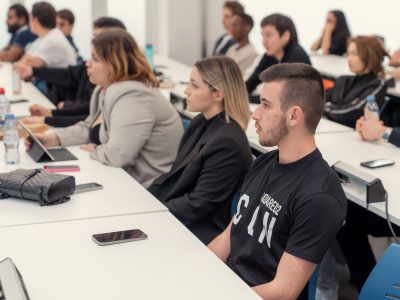
At EU Business School, students are encouraged to cultivate the conditions necessary for deep work through a combination of structured learning environments and practical support. Small class sizes foster focused discussion and meaningful engagement with complex business concepts, while project-based learning encourages sustained analytical thinking rather than superficial task completion.
The school also provides access to dedicated study spaces, digital learning platforms, and academic mentoring designed to help students manage demanding schedules that may include internships and part-time work. By emphasizing disciplined study habits, collaborative yet purposeful learning, and career-oriented time management, EU Business School helps students develop the focus and intellectual depth required to succeed both academically and professionally.